
how small districts can build living accountability dashboards without adding to anyone's workload
By Brooke Goff • April 2, 2026

what your teachers are already writing every afternoon
how small districts can build living accountability dashboards without adding to anyone's workload
The stories were never missing. The system to catch them was.
Four years ago, we sat down with Butler County Schools at the start of their strategic planning process. Superintendent Robert Tuck had reached out because he wanted to understand where Kentucky was heading with local accountability and, more importantly, wanted Butler County to be ahead of it before it was required.
Dr. James Neihof from GRREC was in those early conversations with us. The kind of meetings where you're talking about what deeper learning actually looks like for kids in Butler County and what it means for a student to grow in character, collaboration, communication, problem-solving, and global citizenship. Not as words on a wall. As a lived experience in every classroom.
That work became Butler County's Portrait of a Learner. It's the foundation of their Journey of a Learner dashboard. They became an L3 cohort member. They joined UK Next Gen's Leadership Academy. They have been doing this work longer than most districts in Kentucky, and they have been doing it on purpose.
So when it came time to populate the qualitative side of that dashboard, the human evidence, the stories that show those five indicators aren't just language but are actually happening, we did what seemed logical at the time.
We built a form.
Principals could submit stories. Tag them to an indicator. We'd curate and place them. Clean. Organized. Completely reasonable on paper.
Then we waited.
What came back was thin. Well-intentioned, but thin.
Staged moments dressed up as stories. We were pulling teeth and still coming up mostly empty.
Meanwhile (and this is the part where I have to say we were so far in the weeds we couldn't see the field), Butler County was simultaneously rolling out ParentSquare as its district-wide communication platform.
Teachers were already using it every afternoon. Real messages to real families. A third grader helping a peer work through a hard problem. A student connecting a classroom lesson to something happening in their community. The kind of moment a parent screenshots and saves.
The stories weren't missing.
They were already flowing. To families. Every day. We just had to stop staring at our empty form inbox and start building the infrastructure around what teachers were already doing instead of asking them to do one more thing on top of it.
That realization changed how we think about local accountability dashboards entirely.
And it points directly at the problem most small Kentucky districts are running into right now.
The qualitative data gap, the empty human evidence section, the stale stories nobody has updated since last fall, isn't a story problem. It's a systems problem.
Here's why that distinction matters, and why a feature that launched on March 11th just changed the math for every district using ParentSquare.
the stories are already there
This is the thing we keep seeing across Kentucky districts, and it took us embarrassingly long to name it clearly.
Districts don't have a story shortage. They have a routing problem.
Teachers are communicating with families every single day. Through ParentSquare, through newsletters, through quick updates that capture exactly the kind of moment a local accountability dashboard is supposed to show: a student demonstrating collaboration, a classroom showing what problem-solving actually looks like in practice, a small act of character that doesn't show up on any state assessment.
That content exists. It's being created right now, in every building, by teachers who are already doing the work of connecting with families.
The problem is that nobody built a bridge between where those stories land and where they need to go. So they disappear into a feed. Families see them once. And the accountability dashboard sits empty, waiting for someone to submit the right form.
The content was never the bottleneck.
The infrastructure was.
small districts can't staff their way out of this problem
Here's the solution most districts try first: assign someone to own it.
A communications coordinator. A building-level designee. Someone whose job it is to find the stories, polish them up, and manually place them on the dashboard.
In a large district with a full communications team, that's workable. Barely.
In a small Kentucky district (which is most Kentucky districts) that person doesn't exist. Or they do exist, and they're also the photographer, the social media manager, the crisis communicator, the newsletter writer, and the person who answers the phone when a parent has a concern at 4 pm on a Friday.
Asking that person to also manually curate and place qualitative evidence on a local accountability dashboard is not a strategy. It's a way to ensure the dashboard goes quiet within 6 months of launch.
We saw this coming when we were building Butler County's infrastructure. The tagging protocol we were designing — the system that would route teacher posts to the right indicator on the Journey of a Learner dashboard — needed to work without a human sitting in the middle touching every piece of content.
Not because the people weren't capable. Because the workload was already impossible.
This is an infrastructure problem. And infrastructure problems don't get solved by adding more people to a broken system. They get solved by building a better system.
asking for one more thing breaks the whole system
There's something worth naming directly here, because it gets skipped in most accountability conversations.
When we built that form (the one that came back with staged stories and manufactured moments) we weren't just creating extra work for principals. We were sending a signal. We were indirectly telling teachers that what they were already doing every day wasn't enough.
They needed to perform accountability separately from the work of actually teaching.
That's a dignity problem, not just an efficiency problem.
The best accountability evidence isn't produced on demand. It's captured in the moment: when a teacher notices something worth sharing and takes thirty seconds to write it down for a family. That impulse is already there. Teachers are already acting on it. The system just wasn't built to catch it.
When we went back to the product development team at ParentSquare in December and asked specifically for filtering and tagging functionality that could route posts to a SmartSites accountability dashboard, this was the problem we were trying to solve. Not just the technical gap. The human one.
We didn't want to build something new. We wanted to make the thing teachers were already doing count for more.
the infrastructure to do this now exists
On March 11th, ParentSquare launched a new filtering and tagging feature inside their platform.
Here's what it does in plain language. A teacher writes a post. She was going to write it anyway — it's a Tuesday afternoon update to families about what happened in class today.
She adds one tag. Collaboration. Communication. Problem solving. Whatever indicator fits the moment she's describing.
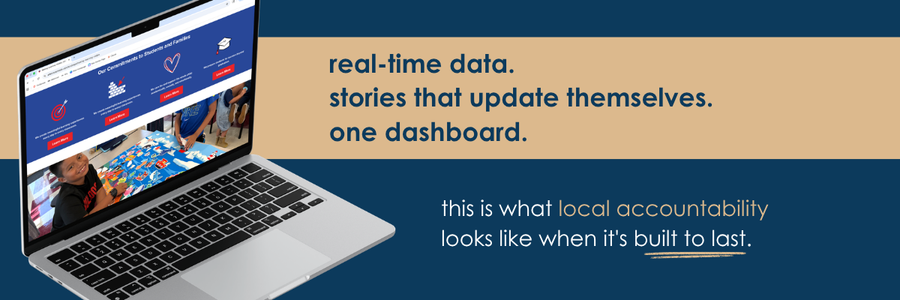
That post routes automatically to the corresponding container on the district's SmartSites accountability dashboard. The Journey of a Learner page updates. The human evidence section fills in. Nobody touched it manually.
For Butler County, this is the piece we have been working toward since those early conversations with Robert Tuck and Dr. Neihof. The dashboard infrastructure we built together — the five indicator pages, the Portrait of a Learner framework, the public-facing evidence that shows what vibrant learning actually looks like in Butler County classrooms — now has a pipeline that feeds itself.
Teachers tag what they're already writing. The right stories land in the right place. The dashboard stays alive because the people already doing the work are the ones feeding it.
This is not a ParentSquare-only solution. The system thinking behind it (build around what people already do, don't ask for one more thing, make the pipeline invisible) applies regardless of your platform. We built a version of this for Allen County using Apptegy's SmartSites, which required custom development at the time. That story is worth reading if you want to understand the three gaps most districts don't know they have.
What changed on March 11th is that the bridge between ParentSquare and SmartSites no longer requires custom code. It's native. It's available now. And for the small districts that have been watching larger systems build living accountability dashboards and wondering how they'll ever get there with the staff they have: this is the answer they've been waiting for.
what this means for your district
If your district uses ParentSquare, reach out to your account rep and ask specifically about the new filtering and tagging functionality. It launched this month.
If you're still trying to figure out what a sustainable local accountability system looks like...if you've built a dashboard that's already gone quiet, or if you're staring down HB 257 requirements and wondering how to get human evidence onto a public-facing page without burning out your team: the answer was never a better form.
It was always a smarter system.
ParentSquare isn't the dashboard. It's the pipeline. And for the first time, that pipeline is available to every district using the platform and not just the ones with the budget to build something custom.
Butler County has been doing this work for four years. They chose to build early, build intentionally, and build in partnership. What they have now (currently under construction) is a Journey of a Learner dashboard that will update itself because the teachers feeding it are just doing what they were already doing, with one extra tag.
That's what this work is supposed to look like.
Your district already has the stories. The question is whether you have the system to catch them.
The Alchemy Collaborative works alongside Kentucky school districts to build local accountability infrastructure, communication systems, and story capture systems that don't add to staff workload. Butler County's Journey of a Learner dashboard was built in partnership with UK Next Gen and through their participation in Kentucky's L3 initiative. If you want to talk through what the ParentSquare update means for your district's dashboard, we'd love to hear from you.
read our most recent posts


the golden lens
sign up to our newsletter to stay updated!
Contact Us
thanks for signing up!
oops, there was a sign-up error.
please try again later.
SHARE THIS